Tampilkan postingan dengan label Europe. Tampilkan semua postingan

Kamis, 14 Maret 2013

Sharing stories of Bletchley Park: home of the code-breakers

For decades, the World War II codebreaking centre at Bletchley Park was one of the U.K.’s most closely guarded secrets. Today, it’s a poignant place to visit and reflect on the achievements of those who worked there. Their outstanding feats of intellect, coupled with breakthrough engineering and dogged determination, were crucial to the Allied victory—and in parallel, helped kickstart the computing age.

We’ve long been keen to help preserve and promote the importance of Bletchley Park. Today we’re announcing two new initiatives that we hope will bring its story to a wider online audience.

First, we’re welcoming the Bletchley Park Trust as the latest partner to join Google’s Cultural Institute. Their digital exhibit features material from Bletchley’s archives, providing a vivid snapshot of the work that went on cracking secret messages and the role this played in shortening the war. Included are images of the Bombe machines that helped crack the Enigma code; and of Colossus, the world’s first programmable electronic computer, used to crack the German High Command code—including this message showing the Germans had been successfully duped about the location for the D-Day invasion.


Second, as a followup to our film about Colossus, we’re pleased to share a personal story of the Bombe, as told by one of its original operators, Jean Valentine. Women like Jean made up the majority of Bletchley Park’s personnel—ranging from cryptographers, to machine operators, to clerks. In her role operating the Bombe, Jean directly helped to decipher messages encoded by Enigma. In this film Jean gives us a firsthand account of life at Bletchley Park during the war, and demonstrates how the Bombe worked using a replica machine now on show at the museum.


We hope you enjoy learning more about Bletchley Park and its fundamental wartime role and legacy. For more glimpses of history, explore the Cultural Institute’s other exhibitions on www.google.com/culturalinstitute.

Read more > Sharing stories of Bletchley Park: home of the code-breakers

Jumat, 01 Februari 2013

Google creates €60m Digital Publishing Innovation Fund to support transformative French digital publishing initiatives

Google has worked with news publishers around the globe for years to help them make the most of the web. Our search engine generates billions of clicks each month, and our advertising solutions (in which we have invested billions of dollars) help them make money from that traffic. And last year, we launched Google Play, which offers new opportunities for publishers to make money—including through paid subscriptions. A healthy news industry is important for Google and our partners, and it is essential to a free society.

Today I announced with President Hollande of France two new initiatives to help stimulate innovation and increase revenues for French publishers. First, Google has agreed to create a €60 million Digital Publishing Innovation Fund to help support transformative digital publishing initiatives for French readers. Second, Google will deepen our partnership with French publishers to help increase their online revenues using our advertising technology.

This exciting announcement builds on the commitments we made in 2011 to increase our investment in France—including our Cultural Institute in Paris to help preserve amazing cultural treasures such as the Dead Sea Scrolls. These agreements show that through business and technology partnerships we can help stimulate digital innovation for the benefit of consumers, our partners and the wider web.

Read more > Google creates €60m Digital Publishing Innovation Fund to support transformative French digital publishing initiatives

Rabu, 19 Desember 2012

Explore Spain's Jewish heritage online

You can now discover Spain’s Jewish heritage on a new site powered by comprehensive and accurate Google Maps: www.redjuderias.org/google.

Using the Google Maps API, Red de Juderías de España has built a site where you can explore more than 500 landmarks that shed light on Spain’s Jewish population throughout history. By clicking on a landmark, you can get historical information, pictures or texts, and a 360º view of the location, thanks to Street View technology. You can also use the search panel on the top of the page to filter the locations by category, type, geographic zone or date.

Toledo, Synagogue Santamaría la Blanca

Information is included on each landmark

This project is just one of our efforts to bring important cultural content online. This week, we worked with the Israel Antiquities Authority to launch the Leon Levy Dead Sea Scrolls Digital Library, an online collection of more than 5,000 scroll fragments, and last year we announced a project to digitize and make available the Yad Vashem Museum’s Holocaust archives. With the Google Art Project, people around the world can also view and explore more than 35,000 works of art in 180 museums.

Read more about this project on the Europe Blog. We hope this new site will inspire you to learn more about Spain’s Jewish history, and perhaps to visit these cities in person.

Read more > Explore Spain's Jewish heritage online

Kamis, 19 Januari 2012

Data Journalism Awards now accepting submissions

Last November, we announced our support for a new Data Journalism competition, organized by the Global Editors Network. The competition is now open to submissions and today we hosted an event at our offices in London to share details on how to compete and win a total of six prizes worth EUR 45,000. The European Journalism Centre is running the contest and Google is sponsoring.


Journalism is going through an exciting—if sometimes wrenching—transition from off to online. Google is keen to help. We see exciting possibilities of leveraging data to produce award-winning journalism. “Data journalism is a new, exciting part of the media industry, with at present only a small number of practitioners,” said Peter Barron, Google’s Director of External Relations. “We hope to see the number grow.”

In data journalism, reporters leverage numerical data and databases to gather, organize and produce news. Bertrand Pecquerie, the Global Editor Network’s CEO, believes the use of data will, in particular, revolutionize investigative reporting. “We are convinced that there is a bright future for journalism,” he said at the London event. “This is not just about developing new hardware like tablets. It is above all about producing exciting new content.”

The European Journalism Centre, a non-profit based in Maastricht, has been running data training workshops for several years. It is producing the Data Journalism Awards website and administering the prize. “This new initiative should help convince editors around the world that data journalism is not a crazy idea, but a viable part of the industry,” says Wilfried Ruetten, Director of the center.

Projects should be submitted to http://www.datajournalismawards.org. The deadline is April 10, 2012. Entries should have been published or aired between April 11, 2011 and April 10, 2012. Media companies, non-profit organisations, freelancers and individuals are eligible.

Submissions are welcomed in three categories: data-driven investigative journalism, data-driven applications and data visualisation and storytelling. National and international projects will be judged separately from local and regional ones. “We wanted to encourage not only the New York Times’s of the world to participate, but media outlets of all sizes,” says Pecquerie. “Journalism students are also invited to enter, provided their work has been published.”

An all-star jury has been assembled of journalists from prestigious international media companies including the New York Times, the Guardian and Les Echos. Paul Steiger, the former editor-in-chief of the Wall Street Journal and founder of the Pulitzer Prize-winning ProPublica, will serve as president.

Winners will be announced at the Global News Network’s World Summit in Paris on May 31, 2012.


(Cross-posted from the European Public Policy Blog)
Read more > Data Journalism Awards now accepting submissions

Minggu, 25 Desember 2011

Remembering a remarkable Soviet computing pioneer

In many parts of the world, today is Christmas—but in Russia and Eastern Europe, which use the Orthodox calendar, December 25 is just an ordinary day. Little known to most, however, it’s also a day that marks the anniversary of a key development in European computer history.

Sixty years ago today, in the Ukrainian capital of Kyiv, the Soviet Academy of Sciences finally granted formal recognition to Sergey Lebedev’s pioneering MESM project. MESM, a Russian abbreviation for “Small Electronic Calculating Machine,” is regarded as the earliest, fully operational electronic computer in the Soviet Union—and indeed continental Europe.

Recently we were privileged to get a first-hand account of Lebedev’s achievements from Boris Malinovsky, who worked on MESM and is now a leading expert on Soviet-era computing.


Turn on captions for the English translation.

Described by some as the “Soviet Alan Turing,” Sergey Lebedev had been thinking about computing as far back as the 1930’s, until interrupted by war. In 1946 he was made director of Kyiv’s Institute of Electrical Engineering. Soon after, stories of “electronic brains” in the West began to circulate and his interest in computing revived.

Sergey Lebedev*

Initially, Lebedev’s superiors were skeptical, and some in his team felt working on a “calculator”—how they thought of a computer—was a step backward compared to electrical and space systems research. Lebedev pressed on regardless, eventually finding funding from the Rocketry department and space to work in a derelict former monastery in Feofania, on the outskirts of Kyiv.

Work on MESM got going properly at the end of 1948 and, considering the challenges, the rate of progress was remarkable. Ukraine was still struggling to recover from the devastation of its occupation during WWII, and many of Kyiv’s buildings lay in ruins. The monastery in Feofania was among the buildings destroyed during the war, so the MESM team had to build their working quarters from scratch—the laboratory, metalworking shop, even the power station that would provide electricity. Although small—just 20 people—the team was extraordinarily committed. They worked in shifts 24 hours a day, and many lived in rooms above the laboratory. (You can listen to a lively account of this time in programme 3 of the BBC’s ”Electronic brains” series.)

MESM and team members in 1951. From left to right: Lev Dashevsky, Zoya Zorina-Rapota, Lidiya Abalyshnikova, Tamara Petsukh, Evgeniy Dedeshko

MESM ran its first program on November 6, 1950, and went into full-time operation in 1951. In 1952, MESM was used for top-secret calculations relating to rocketry and nuclear bombs, and continued to aid the Institute’s research right up to 1957. By then, Lebedev had moved to Moscow to lead the construction of the next generation of Soviet supercomputers, cementing his place as a giant of European computing. As for MESM, it met a more prosaic fate—broken into parts and studied by engineering students in the labs at Kyiv’s Polytechnic Institute.

*All photos thanks to ukrainiancomputing.org.

Read more > Remembering a remarkable Soviet computing pioneer

Rabu, 07 Desember 2011

Saluting Europe’s eTowns

It’s often assumed that big cities benefit the most from the Internet, but we believe the net offers giant opportunities to everyone from urbanites to small town residents, farmers and nature lovers in the far-flung countryside. We recently tested this thesis in our first-ever European Google eTown awards, which recognize those areas that had most embraced the web’s potential over the last year.

The results were fascinating—and surprising. Smaller, quirky and plucky towns came out ahead. Scunthorpe, a steel town in the north of England, topped the U.K.’s list. Caen, a town in rural Normandy not far from the D-Day beaches and famed as the home of camembert cheese, came first in France. Salerno, nestled between the Amalfi and the Cilento Coast led the way in Italy and Elbląg, a remote northern town located in the region of 1,000 lakes won in Poland. In all four participating countries, eTown lists included towns of all sizes.

How did we determine our eTown awards? We broke down the U.K., France, Italy and Poland into all of their thousands of towns and then ranked local areas according to the growth in small businesses using AdWords over the last year. The top towns in each country won Google eTown awards.


The results back up recent research identifying the Internet as a main force driving growth throughout Europe. For example, a recent McKinsey report Internet Matters states that 2.6 Internet jobs are created globally for every job destroyed. Separately, the Boston Consulting Group estimates that by 2015 the web will account for 7.3 percent of Denmark’s GDP, 10 percent of the U.K.’s GDP and 5.5 percent of France’s GDP. The net drives growth of both big and small businesses—indeed another BCG report called “Turning Local” (PDF) makes clear that small businesses with a website grow faster than businesses without a web presence.

We’ve seen this ourselves, in the businesses of all shapes and sizes that we encountered as part of our eTown awards. An entrepreneur in Hartlepool in the U.K. sells golf balls online. A Polish programmer runs a data recovery business from Piaseczno. An plumber directs a heating systems company from Vicenza, Italy and a French retailer has reached new scooter customers online in Reims. Online advertising has helped them grow and reach more customers than ever before. When it comes to the Internet, our eTown awards show that anybody, almost anywhere, can boost a business by going online.

Read more > Saluting Europe’s eTowns

Selasa, 06 Desember 2011

Inaugurating our new French headquarters

Last year, our Executive Chairman Eric Schmidt promised to open a research and development and culture centre in France. Today, Eric returned to Paris to inaugurate our new 10,000-square meter office in a refurbished 19th century Second Empire building near the St. Lazare Train Station. It will be our headquarters not just for France, but our entire Southern Europe, Middle East and Africa operations.

French President Nicolas Sarkozy honored us with his presence. “Why as President, do I make this symbolic move and come to Google?" he asked rhetorically to a packed courtyard auditorium. “I love the United States, and its motto that everything is possible whatever your origins.” President Sarkozy also officially launched the Elysee Palace’s YouTube channel and his visit was shown on YouTube Live, the section of the site where we list all live streamed events.


The President participated in a Google+ Hangout, taking questions from French-speaking Googlers around the world. (“What time is it there?” he asked someone dialing in from California.) On a serious note, he expressed his gratification for how Google has moved to dig deep roots in France. “When I first met Eric, we had a frank conversation,” he recalled, saying his message was clear. “I asked him how long Google was preparing to make money in France without investing here. I told him that Google must have its feet in France.”


Our new Paris headquarters is emblematic of our commitment to one of Europe’s fastest-growing Internet economies. According to a recent McKinsey study that we helped sponsor, the web contributed to 3.2 percent of the French GDP in 2009 and created more than 700,000 jobs during the past 15 years. Between now and 2015, McKinsey estimates that the digital contribution will grow to 5.5 percent of GDP, and 450,000 additional jobs will be created. In order to help accelerate the French digital engine, we’ve launched a Startup Café, an online platform offering information and tools.

Our investment plan for France is ambitious, and extends far beyond buildings. We’re expanding our engineering presence to take advantage of France’s strong engineering talent pool and are making significant academic investments, including a partnership with the French national research center CNRS.

France is a global cultural leader and we’re working hard to partner with French writers, filmmakers and musicians. Over the past year, we've reached an agreement with the biggest French publisher Hachette to scan and sell digital versions of out-of-print books and are providing payment systems for French news publishers from Hachette. YouTube has signed royalty-collection agreements with music copyright societies and our new Cultural Institute will be located in the Paris headquarters. It will aim at driving innovation in cultural preservation, creation and access, not just in France, but across the world.

Just before the President left, he asked to say a few final words. He praised our “dynamism” and wished well our expanded operations, before making a parting promise. “I hope this inauguration is one of a long series,” he said. “If you invite me to another building opening, I will come.”


(Cross-posted from the European Public Policy Blog)
Read more > Inaugurating our new French headquarters

Senin, 28 November 2011

Celebrating innovation in digital journalism

Journalism is changing fast as media businesses adapt and experiment with ways of gathering and reporting the news in the digital age. Here’s news of two contests we’re sponsoring to help stimulate innovation in digital reporting.

IPI News Innovation Contest
We’re pleased to congratulate the first three winners selected by the Vienna-based International Press Institute in its News Innovation Contest. The prizes are part of a $5 million global contest launched by Google last year.

Today’s winners, who will receive grants totalling $600,000, are:
  • World Wide Web Foundation for its Voice-based Citizen Journalism project in France, the Netherlands and Mali. The project will enable voice-based citizen journalists to gather and deliver news in rural areas through community radio and mobile phones.
  • Internews Europe for its crowd-sourced journalism project in five African countries. The project aims to promote expertise in crowd-sourced journalism techniques to contribute to press freedom.
  • Journalism Leaders Programme at the University of Central Lancashire, for its digital media training programme for the U.K. and Turkey. The project will focus on training in data journalism skills and the fundamentals of digital business aimed at disseminating learning to the wider news industry.
This is just the first round of the contest. In 2012, the IPI will consider a new set of proposals and award the remainder of the grant. More details are available at www.ipinewscontest.org.

GEN Data Journalism Awards
In Hong Kong, at the News World Summit hosted by the Global Editors Network, we're announcing a partnership on a new data journalism contest. GEN’s Data Journalism Awards will celebrate the best examples of this new form of journalism from established news organisations and newcomers.


The winners will be chosen by an international jury and prizes awarded at the next GEN conference in Paris next year. Details on how to take part are at http://www.globaleditorsnetwork.org/djawards/.

We look forward to seeing the impact these initiatives will have on digital journalism and hope they will encourage continued experimentation at every level of the media.


(Cross-posted from the European Public Policy Blog)
Read more > Celebrating innovation in digital journalism

Jumat, 25 November 2011

DatenDialog - Big Tent goes to Berlin


In May, we held our first Big Tent conference near London, where we debated some of the hot issues relating to the Internet and society with policy-makers, academics and NGOs. The term "big tent” not only described the marquee venue but also our aim to include diverse points of view.

After the U.K. success, we decided to export the concept. Yesterday we welcomed more than 200 guests in Berlin, Germany to the second Big Tent event, entitled DatenDialog.

This dialogue about data tackled the issue of online privacy from a variety of angles. It was appropriate to hold it in Germany, which is a pacesetter both in its concern about privacy and its ideas for safeguarding personal data. During the one-day event, we debated questions such as: what does responsible collaboration between the tech industry and the data protection authorities look like? Do we need new regulation to manage the Internet and the large amount of data produced in the online world? Who is responsible for educating users and how does the tech industry make sure it builds privacy controls into its products?

Speakers included the German State Secretary for the Interior Cornelia Rogall-Grothe and the Federal Data Protection Commissioner Peter Schaar, alongside international authors and bloggers Cory Doctorow and Jeff Jarvis who appeared via live video chat from the U.S.


The debate was always lively, sometimes polarised—Cory likened amalgamated data to nuclear waste while Jeff appealed to governments not to regulate for the worst case—but all seemed to agree that it was a worthwhile and timely exercise to explore these important issues.

You can watch the highlights soon on our Big Tent YouTube channel, and stay tuned for more Big Tents on a range of topics around the world in the coming months.


(Cross-posted from the European Public Policy Blog)
Read more > DatenDialog - Big Tent goes to Berlin

Kamis, 17 November 2011

Celebrating LEO, the world’s first business computer

This year marks the 60th anniversary of LEO, the world’s first business computer—built by J.Lyons & Co, a leading British food manufacturer at the time that also ran a famous chain of tea shops.

Lyons management had long been keen to streamline their back-office operations. In 1947, two Lyons managers visited the U.S. to learn about the latest business processes, including whether the electronic computers they’d heard about during their wartime service, like ENIAC, might be useful. (At the time, the closer-to-home advances at Bletchley Park were still a well-kept military secret.)

They returned inspired by the possibilities and keen to build a machine of their own. After several years of development, LEO, a.k.a. Lyons Electronic Office, took on its first office job on November 17, 1951—weekly valuations for the bakery division, calculating margins on Lyon’s output of bread, cakes and pies.


Until LEO, computing in a work setting was treated like a specialist bit of kit on a factory production line. Each machine was dedicated to a single task. In essence, they were narrowly defined calculating machines. The vision for LEO, in contrast, was bravely broad. LEO was a single computer capable of handling a whole swathe of accounting and bookkeeping tasks, as well as producing daily management reports.

LEO was such a success that Lyons set up a commercial subsidiary to sell spare time on LEO to other businesses, including the Ford Motor Company, which used it to process the payroll for the thousands of workers at its U.K. plant. Later, Lyons also built entirely new LEOs and sold them to other blue-chip companies of the era. In total, more than 70 LEO’s were built, with the last remaining in service until the 1980’s (not bad for a computer that took up an entire room!).

Today we view IT as critical to any enterprise, but in the 1950s, this was by no means a given, as evidenced by a quote from a 1954 issue of The Economist: “There are those who do not believe in the desirability of introducing anything as esoteric as electronics into business routine.” Things certainly have changed, and in a sense, all modern day businesses owe a debt to the LEO team.

Last week at the Science Museum in London, we were delighted to sponsor a small gathering of early LEO programmers  to celebrate their accomplishments and reminisce about their pioneering work. Today, on this 60th anniversary, we invite you to have a cup of tea and join us in toasting LEO—a remarkable ancestor in IT’s family tree.


Read more > Celebrating LEO, the world’s first business computer

Selasa, 27 September 2011

European Commission President Barroso takes your questions on YouTube World View

(Cross-posted on the YouTube Blog)

Tomorrow, September 28, European Commission President José Manuel Barroso will deliver his annual State of the Union Address. In these turbulent times, we wanted to give people a chance to make their voices heard and ask their questions about the EU. So we teamed up with broadcaster Euronews and invited President Barroso to answer your questions in a special, live YouTube World View interview that will take place on Thursday, October 6 at 10:00am Central European Time.

Starting today, we invite you to submit your questions for President Barroso via youtube.com/worldview. Questions can be on any topic, from the Euro crisis and austerity measures to growth and jobs, from foreign policy and immigration to ethnic minority issues, human rights and the environment. You can ask written or video questions—and view and vote on other people’s questions—in any of the European Union’s languages, thanks to Google Translate.

During the interview on October 6, hosted by Euronews anchor Alex Taylor, the President will answer a selection of the most popular questions, as determined by your votes. The interview will be streamed and broadcast in multiple languages on both YouTube and Euronews.


President Barroso’s interview will be the first multi-lingual livecast in the World View series, which gives anyone with an Internet connection the ability to pose questions, vote on what’s most important to them and get answers directly from senior politicians and world leaders. President Barroso’s interview follows interviews with U.S. President Obama, President Kagame of Rwanda, U.K. Prime Minister Cameron, Spanish Prime Minister Zapatero and Israeli Prime Minister Netanyahu.

Whatever your question, President Barroso wants to hear from you. Be sure to submit your question via the World View channel before midnight CET on Wednesday October 5.

Read more > European Commission President Barroso takes your questions on YouTube World View

Kamis, 28 Juli 2011

Catch the London Underground with Google Maps

(Cross-posted on the Lat Long Blog)

Starting today, you can get public transport directions for London within Google Maps. One of Europe’s largest metropolitan areas, London is a major destination for both business travelers and tourists. More than 1 billion passengers are serviced by Transport for London (TfL) every year across over 18,000 bus stops and over 250 Underground stations.

Let’s say you’re at Trafalgar Square, and you want to visit Madame Tussauds. With a simple directions search, you’ll see all the possible public transport connections. In Maps, click “Get directions” in the left-hand panel, and then the train icon to see public transport directions. Enter your departure location next to A, and your destination next to B. These can be either street addresses or names of popular places, businesses or restaurants. When you’re done, click the “Get directions” button and suggestions for your trip will appear below.


Public transport directions are available on both Google Maps and Google Maps for mobile, so you always have access to a trip planner. When you’re on mobile, Maps even uses your current location to determine the best trip to your destination. Just search for your destination location, select it on the map and choose the “Directions” option. The suggested trips will be based on your location by default, and provide you multiple alternatives whenever possible.

If you’re using an Android-powered device, you can also get public transport directions with Transit Navigation (Beta) in Google Maps. With this new feature, which we launched earlier this month, you’ll get alerts when it’s time to get off the bus or train at your destination or to make a transfer. Transit Navigation is available in all regions where public transport directions are available, including London.


TfL is among the first agencies in a major European city to make its timetable information publicly available through the London Datastore. We’re strong supporters of open data and bringing information out into the open, and believe that making information publicly accessible can be an enormous engine of economic growth and innovation. ITO World has been a great partner in this launch by ensuring TfL’s data was adapted correctly and ready for our use.

Public transport directions are available for all Underground, bus, tram and Docklands Light Railway (DLR) lines, and we’ll include more public transport information as soon as it’s available. Whether you use public transport every day or infrequently, as a commuter, on a business trip or as a tourist, we hope that public transport directions in London make planning your trips more convenient!

Read more > Catch the London Underground with Google Maps

Jumat, 22 Juli 2011

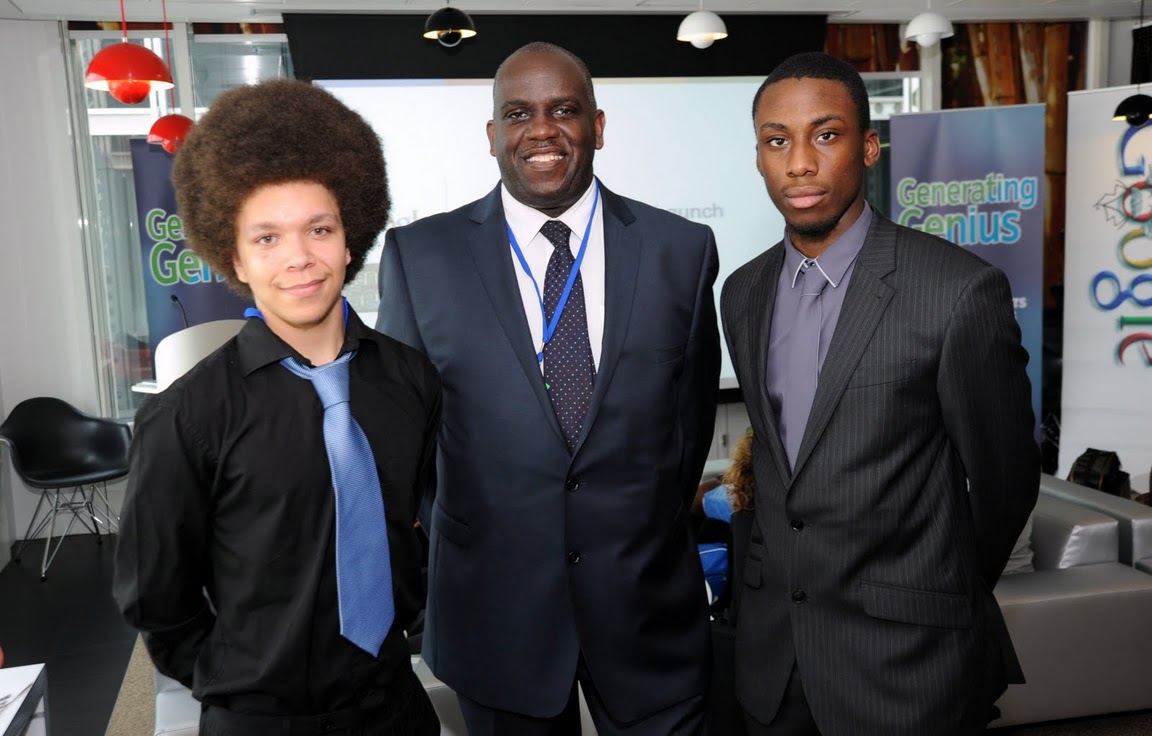
Generating Genius in the U.K. with young black talent

On July 14, Google U.K. launched a partnership with Generating Genius at an event in our London office. Google director Adrian Joseph, Member of Parliament Simon Hughes and advisor on culture and youth Munira Mirza spoke alongside Generating Genius founder Tony Sewell. They stressed the importance of encouraging students from underrepresented backgrounds to receive higher education degrees and inspiring them to become innovators in the technology industry. Afterward, two program participants shared their Generating Genius experiences and their plans for university this fall.

Joining forces with Generating Genius is part of our ongoing commitment to provide exceptionally talented young black students from London’s inner city schools with the key computing and technology skills needed to apply for the very best computer science degrees. We believe it’s crucial to get students engaged in computer science early and enable them to become creators—not just consumers—of technology.

Students accepted into the Generating Genius program are guided via mentors through engineering summer schools and weekend programs for a full five years (from 13 to 18 years of age). Early results of the program have been fantastic: all of the first participants to graduate from the program have received offers to attend elite universities this autumn. Ninety-five percent of them are the first in their families to go on to higher education. Google's funding is enabling Generating Genius to include girls this year for the first time, as well as helping to expand upon the computer science component of the program.

Director of Generating Genius Tony Sewell (center) and two students who have completed five years in the program and are now headed to elite universities to study computer science and physics.

This partnership follows on the heels of the Top Black Talent Program that we kicked off in April, which recruits talented computer science students from African Caribbean Society chapters at U.K. universities for a mentoring program at Google. Paired with a Google mentor, the students attended a series of talks and workshops, including career-focused sessions with resume and interviewing advice and technical discussions that provided real-life insights into the tech industry.

You can hear more from Googlers, executives, scholars and partners about our programs and initiatives for minority students by watching our You Tube video. For further details on the Top Black Talent program or to register for the next cohort of Top Black Talent students, please get in touch. And for more on our general education outreach, visit google.com/edu.

Read more > Generating Genius in the U.K. with young black talent

Kamis, 02 Juni 2011

Practical steps towards a greener, energy-efficient cloud

(Cross-posted from the European Public Policy Blog)

Update June 14, 9:14am:
Videos of all the presentations at the Data Center Summit are now available on our website.

Data centers are very important to us—they’re critical to the cloud services we deliver. Over the last 12 years, we’ve put a lot of effort into minimizing the amount of energy, water and other resources we use—because it makes financial sense, and because it’s good for the environment too. That work means that today, we use half the energy of a typical industry data center.

Last week, we brought together more than 150 industry professionals in Zürich, Switzerland for our second conference on data center efficiency. Since our first conference two years ago in the U.S., the industry’s come a long way, with large operators now very focused on energy efficiency.


With “free cooling” we can dramatically reduce energy consumption by using the local environment to cool servers, instead of energy-intensive chillers. In our data centers we use both air cooling and evaporative cooling—and we revealed the details of the seawater cooling system we’ve custom-engineered for our new data center in Hamina, Finland.


Google is lucky enough to have the resources and experts to continually improve efficiency. But around 70% of the world’s data centers are operated by companies that probably don’t.

That’s why we shared five simple and low-cost steps that any company, large or small, can use. These include using plastic meat locker curtains to separate hot and cold air, or welding your own air-conditioning chimney out of cheap sheet metal. These techniques are proven to increase energy efficiency, reduce electricity consumption and improve environmental footprint.

We also announced that we’re now participating in the European Commission’s Code of Conduct for Data Centres, a framework for designing and operating data centers efficiently. It ties in closely with the way we build and run our facilities, and has a robust checklist of efficiency best practices that are well worth trying out.

The main take-away was that there is no magic in data center efficiency. With the right information and a bit of creativity, anyone can make their computing infrastructure efficient. If you operate a data center or server room, please visit our website and make use of the techniques we’ve outlined. Videos of all the presentations from the Summit will be available on the site next week.

Read more > Practical steps towards a greener, energy-efficient cloud

Rabu, 25 Mei 2011

Inside the Big Tent

(Cross-posted from the European Public Policy Blog)

At our European Zeitgeist event, held annually near London, we traditionally erect a large marquee for a partner dinner and entertainment. This year we wondered if there was anything else we could do with the space once Zeitgeist was over. In that instant, the Big Tent was born.

Canvas aside, the term "big tent" has, of course, a political connotation. Wikipedia defines it as "seeking to attract people with diverse viewpoints...does not require adherence to some ideology as a criterion for membership." That just about sums up the idea behind last week’s Big Tent conference, which focused on debating some of the hot issues relating to the internet and society.

We invited the advocacy groups Privacy International and Index on Censorship—both of whom have criticised Google in the past—to partner with us in staging the debates, and sought diverse viewpoints among the speakers and the delegates.

Topics on the agenda included: what was the role of technology in the revolutions in the Middle East? What are the limits of free speech online? Do we need tougher privacy laws or are we in danger of stifling innovation? Can technology and access to information be used to help prevent conflict?

The result was a stimulating day of debate featuring the likes of Big Brother television producer Peter Bazalgette, Mumsnet founder Justine Roberts and the U.K. Culture Secretary Jeremy Hunt alongside Googlers including Eric Schmidt, Google Ideas’ Jared Cohen and the Egyptian activist Wael Ghonim, and a highly engaged and knowledgeable audience of NGOs, policy advisers, tech businesses and journalists.


You can watch highlights on YouTube and see event feedback on Twitter. We hope to bring the Big Tent to other regions over the coming year.

Read more > Inside the Big Tent

Rabu, 23 Februari 2011

Investing in news innovation in Europe

(Cross-posted from the European Public Policy Blog)

Journalism is changing fast. And as news businesses experiment with new ways of creating and delivering journalism in the digital age, Google is keen to play its part on the technology side. Over the last year, we’ve been partnering with publishers around the world to develop technological solutions—including, most recently, One Pass—to find new and engaging ways of presenting stories online and to generate greater revenues.

As well as our focus on technological experimentation, we’re also investing at the grassroots level. Last October we announced that we would be giving $5 million in grants to non-profit organisations working on developing new approaches to journalism. At that time, we allocated around 40% of the total fund to the Knight Foundation in the U.S.

Today, we awarded a $2.7 million grant to the International Press Institute, based in Vienna, which will be used to sponsor the IPI News Innovation Contest. The contest seeks to find and fund breakthrough ideas that will have a lasting impact on the future of digital news in communities across Europe, the Middle East and Africa.

Grants will be awarded to both non-profit and for-profit organisations working on digital journalism initiatives, including open-source and mobile technology projects created by or for journalists and distributed in the public interest. From today until June 1, the IPI will invite proposals from around the region for projects devoted to online innovation in journalism, new economic models for news and training in digital reporting.

The IPI has a long tradition of working on innovation in journalism, freedom of expression and other important issues. We’re sure they’ll be able to find and advance some great digital journalism projects over the next couple of years—and we encourage anyone with innovative ideas, large or small, to apply for a grant from the IPI. In the meantime, we’ll continue to work with the news industry to help develop new projects, products and experiments that make it possible for journalism to thrive online.

Read more > Investing in news innovation in Europe

Jumat, 03 Desember 2010

International tourists find the Polish seaside through Google AdWords

(Cross-posted on the Google Small Business Blog)

Sebastian Hejnowski’s parents built the Villa Zdroj Bed and Breakfast in 2002 to share Poland’s beauty with weary travelers. Located in Miedzyzdroje, a city on the coast of Polish island Wolin, Villa Zdroj is one of the island’s first modern bed and breakfasts.

Sebastian’s parents handle reservations, property development and sometimes breakfast. Sebastian runs the advertising efforts for his parents’ Villa, including Google AdWords. “When we first started our AdWords campaigns, we focused on Poland but we soon realized that there was increasing interest from our neighboring countries,” says Sebastian. When he noticed an upward trend in drop-in visitors from other countries, he decided to launch campaigns across Poland’s borders as well.

Villa Zdroj - courtesy of Marcin Matecki Photography

According to Sebastian, the variety of outdoor activities combined with the relatively inexpensive cost of Polish tourism make Wolin a vacation paradise for Germans and Scandinavians. “Germans and Scandinavians were coming to Miedzyzdroje, but mostly staying in expensive five-star hotels,” says Sebastian. “B&B’s were never an option since they didn’t know where to find them.” So Sebastian made Denmark, Germany, Norway and Sweden his first international targets. The strategy proved correct: “We were one of the first Polish B&B’s to create a website in English. When we targeted an AdWords campaign to these people, they started calling and booking reservations.”

As time went on, Sebastian noticed that Poland had become more and more accessible to Europeans due to an increase in flights to the area. To capitalize on this trend, Sebastian expanded his AdWords campaigns even beyond bordering countries. “With time we extended the campaign to the Great Britain and the Netherlands.” says Sebastian. “Europeans tend to explore new places and travel extensively.”

Sebastian with his family - courtesy of Marcin Matecki Photography

Today, foreigners account for more than half of Villa Zdroj’s guests. And Sebastian estimates that up to 60% of those international guests book Villa Zdroj because they found his AdWords ads.

Thanks to his effective targeting, Sebastian now sells out all of the villa’s rooms during peak summer travel season. He adjusts his ad campaigns to reflect availability: “In summer, we track vacancies and adjust our campaigns accordingly. We pause the campaigns if we’re booked a few weeks out.”

In 2012, Poland will host the Euro Cup and Sebastian’s dad is already getting ready for an influx of visitors. “My father is considering buying a big projector so everyone can watch the games together in the communal room,” says Sebastian. “We’re already excited to share the Polish seaside with more out of town visitors!”

Learn more about Villa Zdroj Bed and Breakfast and Sebastian’s success with online advertising in this short video (it's in Polish, but you can view captions).

Read more > International tourists find the Polish seaside through Google AdWords

Selasa, 23 Maret 2010

European Court of Justice rules in Google’s favour

Google aims to provide as much information as possible to users so that they can make informed decisions. For this reason, we have been awaiting a series of decisions by the European Court of Justice that explore the extent to which trade mark rights can be used to restrict information available to users. The first of those decisions was delivered today.

The question before the court was whether advertisers should be allowed to choose keywords freely when reaching out to users on the Internet. In other words, if advertisers are allowed to show advertisements when another company's brand name is entered as a search query.

Trade marks are part of our daily life and culture, helping us to identify the products and services that we may be looking for. They are key for companies to market and advertise their products and services. But trade mark rights are not absolute.

We believe that user interest is best served by maximizing the choice of keywords, ensuring relevant and informative advertising for a wide variety of different contexts. For instance, if a user is searching for information about a particular car, he or she will want more than just that car’s website. They might be looking for different dealers that sell that car, second hand cars, reviews about the car or looking for information about other cars in the same category.

And, contrary to what some are intimating, this case is not about us arguing for a right to advertise counterfeit goods. We have strict policies that forbid the advertising of counterfeit goods; it's a bad user experience. We work collaboratively with brand owners to better identify and deal with counterfeiters.

Some companies want to limit choice for users by extending trade mark law to encompass the use of keywords in online advertising. Ultimately they want to be able to exercise greater control over the infomation available to users by preventing other companies from advertising when a user enters their trade mark as a search query. In other words, controlling and restricting the amount of information that users may see in response to their searches.

Today, the Court confirmed that Google has not infringed trade mark law by allowing advertisers to bid for keywords corresponding to their competitors’ trade marks. It also confirmed that European law that protects internet hosting services applies to Google’s AdWords advertising system. This is important because it is a fundamental principle behind the free flow of information over the internet.

Our guiding principle has always been that advertising should benefit users, and our aim is to ensure that ads are relevant and useful. We will study the decision as we move forward in order to make sure that we continue to deliver advertising that is perceived as both valuable and relevant by our users.

Read more > European Court of Justice rules in Google’s favour

Rabu, 10 Maret 2010

A digital renaissance: partnering with the Italian Ministry of Cultural Heritage

The Renaissance, Europe's period of cultural, political and scientific rebirth, began in Florence around 600 years ago. At Google we're interested in a (small “r”) renaissance of a different kind — a digital one. Since the launch of Google Books, we’ve been working with libraries and publishers around the globe to bring more of the world's books to more readers around the globe. Any school child should be able to access the works of Petrarch, Dante or Vico (or, if they're so inclined, Machiavelli). In the case of these more famous authors, this is already largely possible, but what about the work of Guglielmo il Giuggiola or Coluccio Salutati? We want all of the great literature and writings of Italy to be accessible to the general public.

Today we’re announcing an agreement with the Italian Ministry of Cultural Heritage that will push this vision forward. Working with the National Libraries of Florence and Rome, we’ll digitize up to a million out-of-copyright works. The libraries will select the works to be digitized from their collections, which include a wealth of rare historical books, including scientific works, literature from the period of the founding of Italy and the works of Italy's most famous poets and writers. It marks the first time we’ve ever joined forces with Italian libraries, and the first time we've worked with a ministry of culture.

Around Europe and the rest of the world, we are effectively witnessing a digital renaissance, with an increasing number of organizations running ambitious and promising book digitization projects. We're not the only ones who have seen the need to bring the world's books into digital form. Digitization of books is a tremendous undertaking, requiring the joint effort of a great number of public and private stakeholders. For this reason, we’re supportive of many other efforts at digitization, such as the European Commission's Europeana. We want to see these books have the broadest reach possible — the books we scan are available for inclusion in Europeana, of which the Florence Library is a contributing member, and other digital libraries. The more of the world's historical, cultural treasures we can bring online, the more we can unlock our shared heritage.

We believe today’s announcement is an important step, and we look forward to working with more libraries and other partners. We envision a future in which people will be able to search and access the world's books anywhere, anytime. After all, Antonio Beccadelli and Anastasius Germonius — like Shakespeare and Cervantes — are part of our human cultural history.

Read more > A digital renaissance: partnering with the Italian Ministry of Cultural Heritage

Kamis, 25 Februari 2010

A meeting of the minds: Google's 2010 EMEA Faculty Summit

As the world's premier athletes assembled in Vancouver for the Winter Games, Googlers in the equally snowy Zurich, Switzerland were preparing for a prestigious event of a different sort. On February 8, 100 top academics from 62 leading universities throughout EMEA (Europe, the Middle East and Africa) descended upon our Zurich engineering headquarters for our third annual Faculty Summit — three days of in-depth technical presentations, discussions and networking sessions, all targeted at strengthening partnerships with EMEA's foremost computer science thinkers. Like their athletic counterparts in Vancouver, Faculty Summit attendees face big challenges. EMEA is a huge and very diverse region where companies and universities alike have huge mountains to climb. By sharing information about our projects, plans and initiatives, we hope to foster mutually beneficial relationships with our academic colleagues and their universities — working together to solve the big problems and drive technology forward.


We designed the Summit to allow maximum potential for debate, networking and reflection. Attendees participated in day-long "stream" discussions on themes ranging from privacy and security — with the participation of leading researchers such as Ross Anderson (University of Cambridge) — to natural language technologies, featuring NLP expert Fred Jelinek (Johns Hopkins University). Academics selected from a range of opt-in "teach the teacher"-style workshops on Google tech (including mobile platforms, MapReduce and web technologies). Additional events included a Google Wave demo geared towards educational use and special sessions for guests from Africa and the Middle East, showcasing Google's ongoing work in these regions. This year, we added extra time for 1-1 break-out sessions, in which academics and Google engineers met, chatted and developed ideas in an intimate, face-to-face setting.

The Summit also gave us a chance to see long-term relationships maturing and generating concrete outcomes inside and outside academic settings. Notable guests included keynote speaker Professor Andy Hopper, Head of the Cambridge Computer Lab, whose research initiative Computing for the Future of the Planet (CFTFP) received a Google Focused Research Award earlier this month. Andy's project promises major results in the areas of privacy and green computing research. We were also happy to welcome back former Google Visiting Faculty member Professor Hannah Bast (University of Freiburg). Hannah recently completed a year-long sabbatical with our Zurich development team for Transit in Google Maps, contributing major improvements to an application that started out as a 20 percent project and is now available in over 400 cities around the world. Privacy and security expert Dr. Frank Stajano (University of Cambridge) — our newest Visiting Faculty member — and Sara Adams, Anita Borg Scholar, former Google intern and current software engineer, joined us from the Munich office where they're working on privacy-related projects. We also had several Faculty Research Award winners in attendance, including Dr. Simon Harper (University of Manchester), Dr. Miles Osborne (University of Edinburgh), Lawrence Muchemi (University of Nairobi) and former Visiting Faculty member Dr. Hinrich Schuetze (University of Stuttgart). The Faculty Research Award supports academics working within universities on areas of mutual interest; for instance, Lawrence's Award-funded project creates a new mobile application development course for Kenyan students, while Hinrich and his Stuttgart team are improving search engine results by investigating the structure of queries. Hinrich, Lawrence and our other awardees offer examples of how partnerships can lead to amazing results, on local to global scales. We hope their stories inspired both academic and Googler attendees to take advantage of existing programs and help build new opportunities for all tech users.

Our engineering teams in EMEA and our academic partners have lots of work to do in 2010. This year's Faculty Summit offered an opportunity to explore new solutions, kick-start collaboration and prove, yet again, that our combined efforts always yield results far greater than the sum of their parts! For more information about how Google supports university programs and partnerships, check out our Google Research site and stay tuned for news of the North America Faculty Summit — planned for late July.

Read more > A meeting of the minds: Google's 2010 EMEA Faculty Summit
 
 
Copyright © Komokid
Blogger Theme by Blogger Designed and Optimized by Tipseo